Metos Beta is now open for qualifying courses Learn about Metos Apply for access
Why TurfLogic

Better data.
Better golf.

Golf course management has relied on observation for decades. TurfLogic adds objective, continuous intelligence — finding problems before they surface.

Our approach
The Platform

One picture.
Complete clarity.

Every instrument TurfLogic uses feeds a single outcome: an objective, continuously updated picture of your course's health.

Open TurfScore
Featured Courses

Real courses.
Real data.

Every club in the TurfLogic network is a live proof of concept — stress found early, interventions targeted, turf health trending upward.

Learn Why
The Platform
Featured Courses
Open TurfScore ↗ Talk to Us
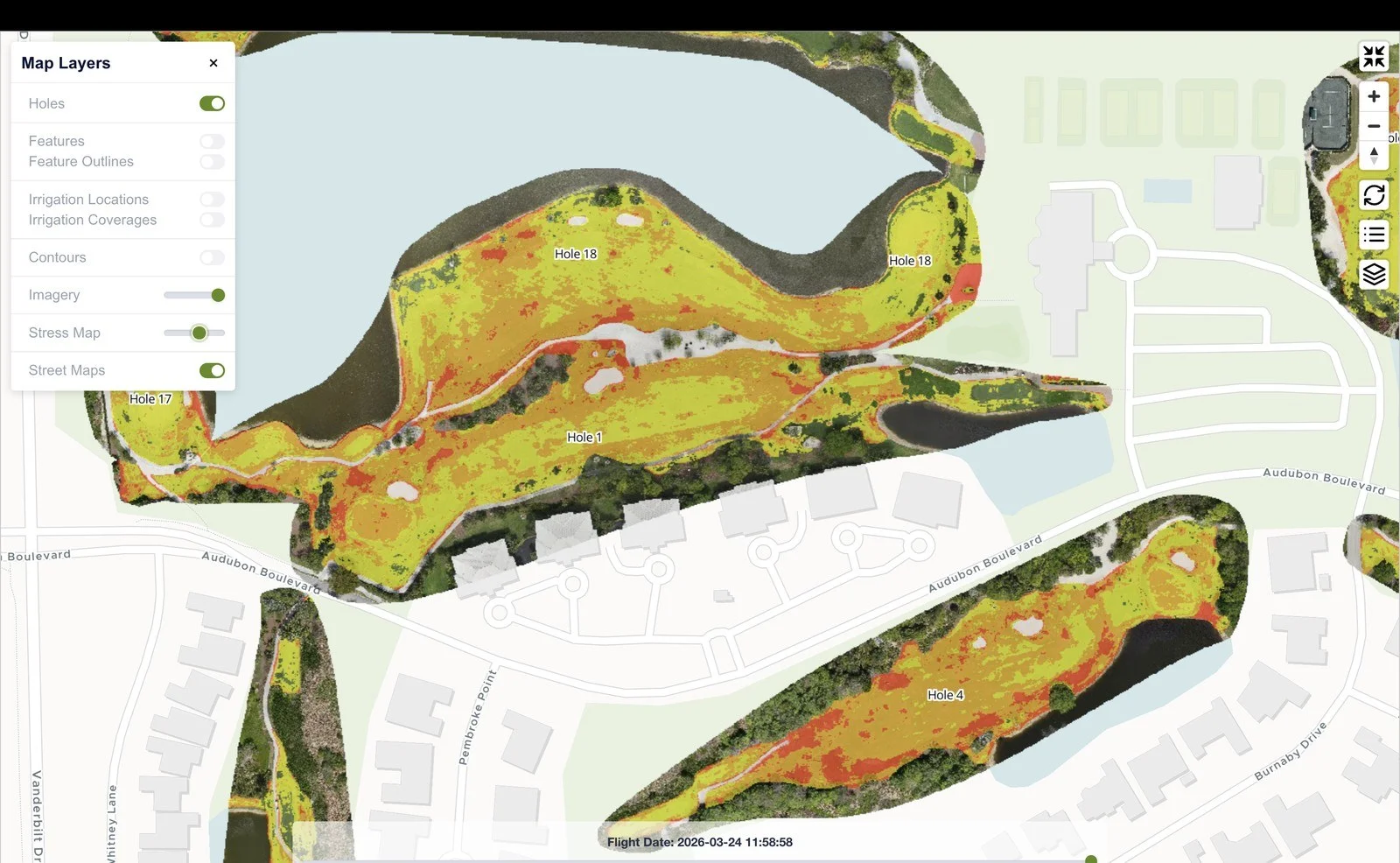
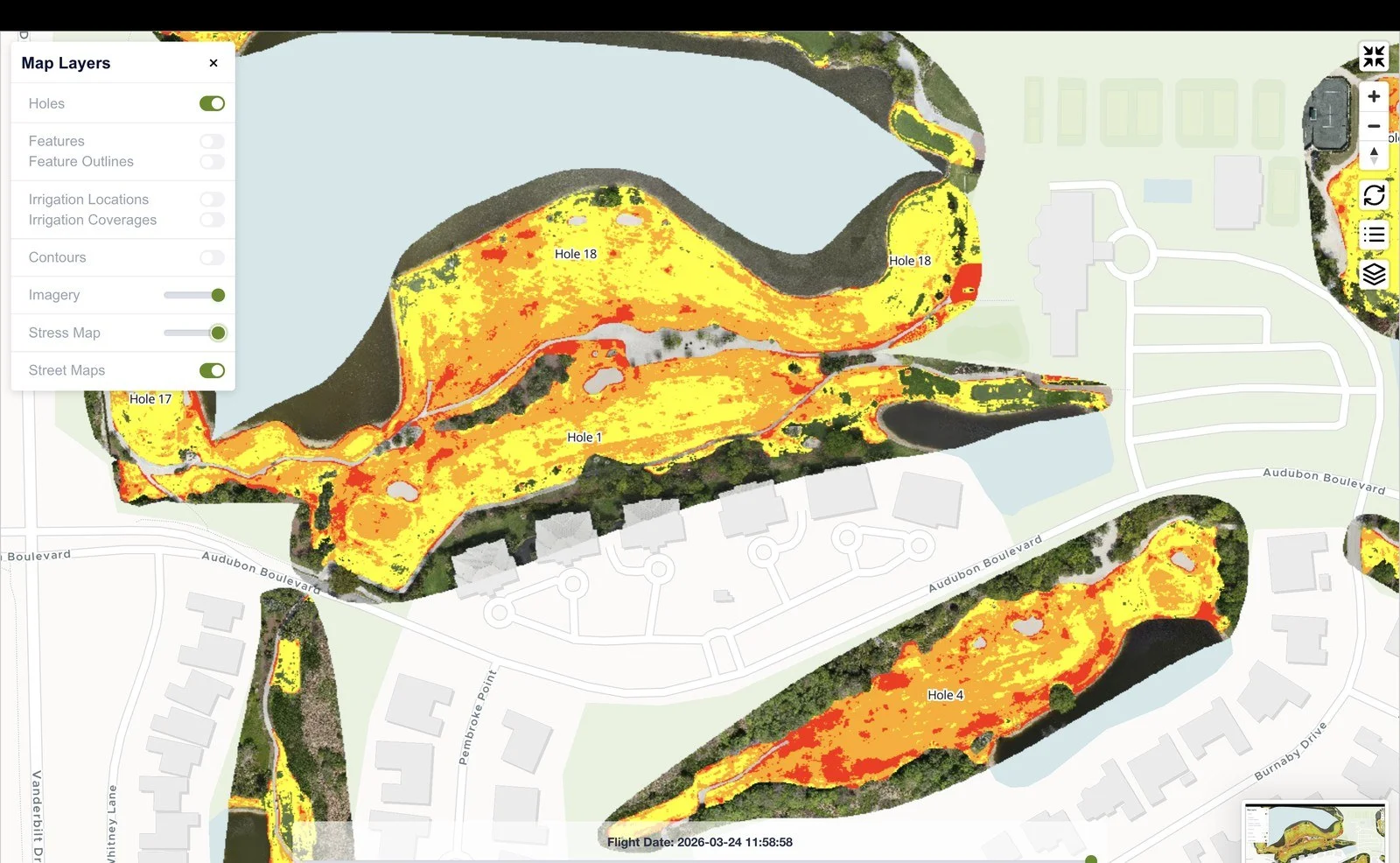
Full-course stress map — Audubon Country Club
The Platform

Stress
Maps

Four stress groups. Sub-meter resolution. Updated after every drone flight — weeks before problems reach the surface.

From clean aerial
to complete intelligence.

The same hole. The same flight. One view shows you what any eye can see — the other shows you what the turf is actually doing. Stress that won't be visible for three more weeks is already mapped, already quantified, already actionable.

Toggle between imagery layers in TurfScore in a single click. Your superintendent sees the same map you're looking at — with field notes, interventions, and historical comparison attached.

Hole 1 — Clean aerial view Clean Aerial
Hole 1 — Stress overlay Stress Map Active
The Four Groups

Color-coded by
clinical severity.

TurfLogic's multispectral analysis classifies every pixel of turf into one of four stress groups — based on reflectance signatures in bands invisible to the human eye. Each group has a defined intervention priority.

Healthy
Group 1
Turf performing at or above baseline. No intervention required. Actively monitored for early drift.
Invisible Stress
Group 2
Measurable decline in reflectance. Stress is present but not yet visible. The optimal intervention window.
Visible Stress
Group 3
Surface symptoms beginning to appear. Recovery is still fast and inexpensive. Acting now avoids escalation.
Unhealthy
Group 4
Significant tissue damage. Recovery is slower and more costly. Origin is traceable in the historical timeline.
Sub-meter stress map resolution detail
Resolution

Sub-meter accuracy.
Every square foot mapped.

Field Detail

Stress at the
square-foot level.

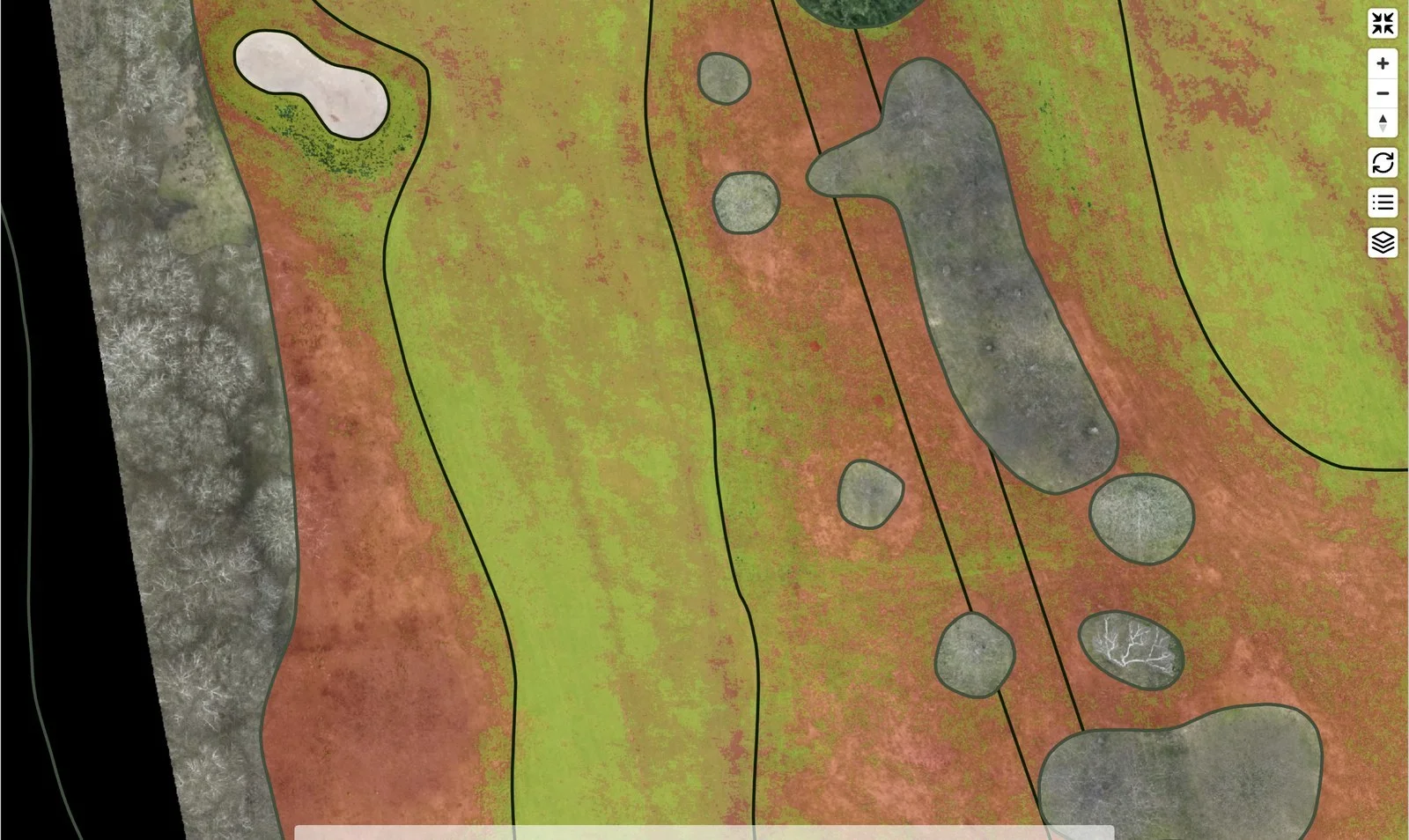
Because TurfLogic flies at low altitude with calibrated multispectral sensors, the resolution resolves individual turf plants. Compaction patterns, irrigation shadows, and disease progression are spatially exact — not estimated.

Stress map closeup — detail view 1
Green Complex
Approach and collar stress identified independently from putting surface health. Each zone scored separately.
Stress map closeup — detail view 4
Fairway Corridor
Stress gradients reveal irrigation coverage gaps and wear patterns concentrated in high-traffic lines.
Stress map closeup — detail view 5
Tee Box & Surrounds
Tee boxes tracked independently per zone. Rotation recommendations tied to stress progression over surveys.

Rigorous process.
Every flight.

The stress map isn't a photograph — it's a derived data product. Each flight generates raw multispectral reflectance, which is calibrated, classified, and layered against your course's prior surveys before the map is published.

01 — Capture
Drone flight
Calibrated multispectral sensors capture NIR, red, and green reflectance across the full course at low altitude.
02 — Calibrate
Radiometric correction
Raw reflectance is corrected for sun angle, atmospheric conditions, and sensor variance to ensure survey-to-survey comparability.
03 — Classify
Four-group model
Each pixel is assigned a stress group based on its reflectance signature relative to the course's own healthy baseline.
04 — Publish
Live in TurfScore
The finished map appears in the TurfScore platform — searchable, zoomable, overlaid with your feature zones, and linked to the historical archive.
See It on Your Course

Your course,
mapped precisely.

Tell us your course. We'll show you exactly what a stress map looks like on your fairways, greens, and tee boxes — with your own turf, your own stress patterns.

Talk to Us Open TurfScore ↗